


Museum of the American Revolution
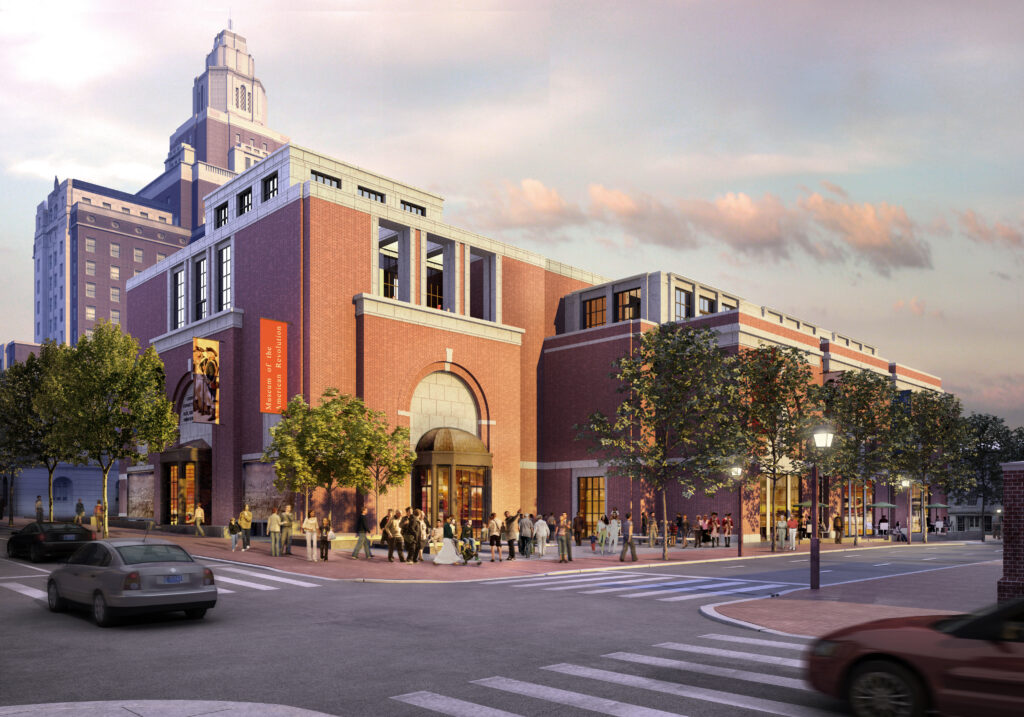
Keast & Hood provided structural design for the new museum, as well as one of its exhibits, the support of George Washington’s marquee tent. The 30,000 square foot building houses permanent and changing exhibit galleries, two theaters, and administrative and educational space. The museum embodies a commitment to preserve the history of the American Revolution and to amplify the historic character of the surrounding Independence National Historical Park.
The building consists of a steel frame supporting concrete slabs on metal deck and partially restrained moment frame lateral system paired with a façade consisting of precast concrete panels overlaid with half-brick. The project is complicated by a confined urban site, a tight schedule with strict design review criteria, and complex intermediate layered framing to accommodate interstitial support spaces and building setbacks. Large concrete encased cantilevered framing was necessary to support the heavy, niche-accented precast panel façade and avoid the existing foundations of adjacent buildings. An articulated elliptical stair with hidden hanger supports is a main architectural statement of the building.
The project utilizes Building Information Modeling (BIM) and LEED Gold certification is anticipated.
The Design
4-story structural Steel framed building with a basement. It is on slightly less than an acre of land. The 118,000 sf building rises about 78 ft above street level. Exhibit and theater spaces will occupy portions of the ground floor and much of the second floor, while offices and mechanical equipment will live on the third and fourth floors.
(c) RAMSA